Sunday, March 28, 2010

Overheard in Peru

"What? That's a district in Lima!"
- A Peruvian friend, after I told him Switzerland is only home to seven million people.

My Lima hostal

Loki hostals are synonymous with heaven for backpackers trailing through Peru and Bolivia. A friend in Ecuador recommended them, and the Loki in Lima has lived up to its reputation. It hosts a bar, a pool table, free internet, cheap bunkbed-filled rooms and an incredible array of travelers. As one Argentine put it, "modern-day Babel is Loki"-- except everyone understands each other despite the numerous language barriers. Everyone, that is, save the neighbors. As I was exiting the rather noisy bar, an egg flew over the outside wall and smashed onto the patio. Apparently the multicultural party world that is Loki can be a little bothersome...

Friday, March 26, 2010

Huanchaco

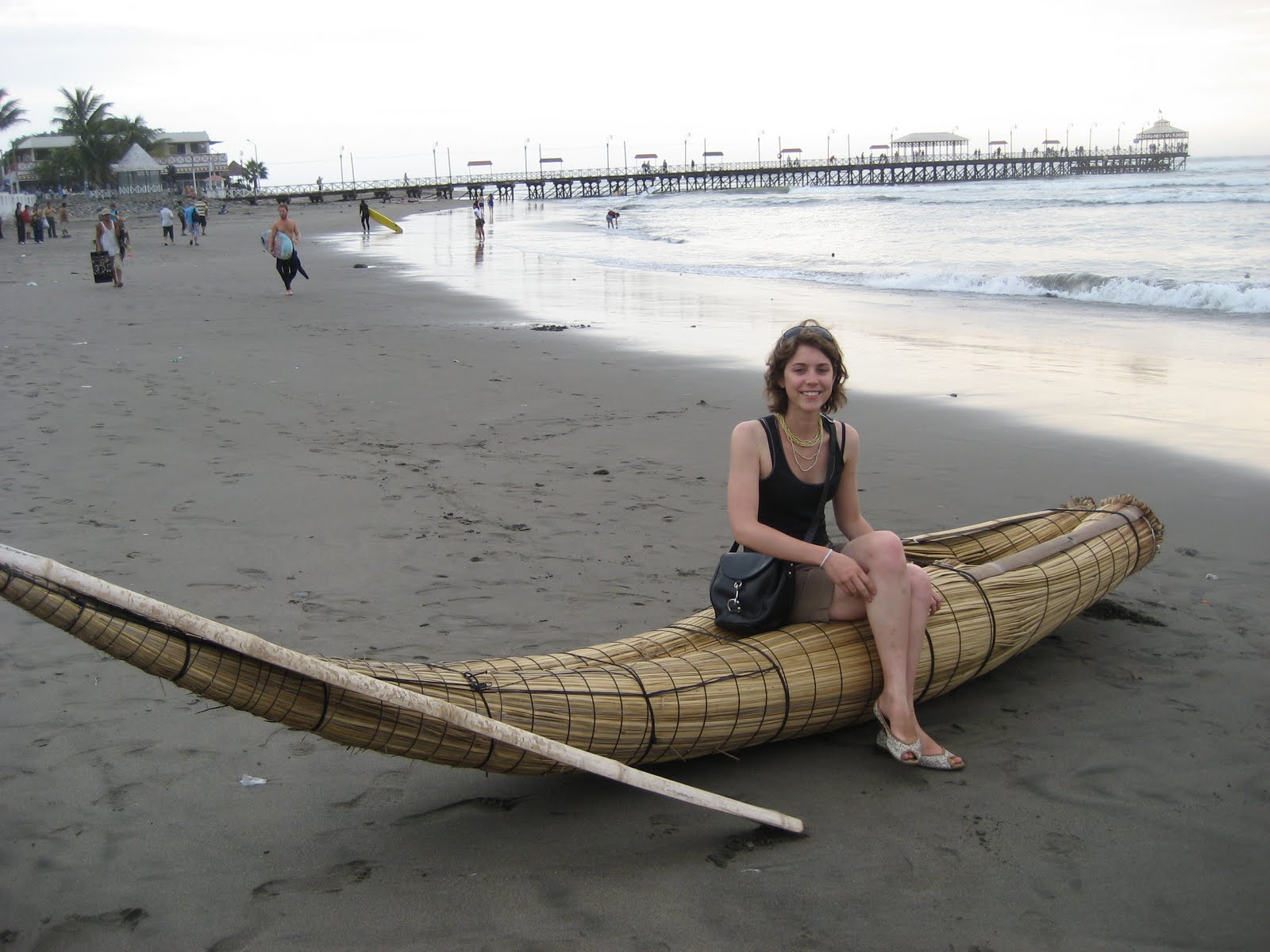
The beach town of Huanchaco presents a typical, if never boring scene-- surf, tourists, sand, sun and waves. But conspicuously present are caballitos de totora, a hilariously-shaped boat created more than 3000 years ago. It's still used for fishing-- and endless photo ops-- in Huanchaco.


Fisherman unknotting his net. He told me controling the boat was simply a question of equilibrium. "Do you ever fall?" I naively asked. "Never!" he replied.
Sunset and resting boats.

I stayed on land.

The Chimu

The Chimu, a pre-Incan civilization that stretched through much of coastal Peru between 900 and 1460 A.C. They worshiped the moon, engaged in human sacrifices as an honour and built a vast city, Chan Chan, in present-day Trujillo. The town used to cover 20 km squared, but the crumbly walls that remain are a poor testament to the former might of their people. It is still a very impressive sight.


View of the temple.


Excavations, renovations-- its still being built!

A frieze that represents the changing tides.

Corridor. Don't get lost in this temple-- there is but one entry and exit...

Me in the middle of the temple.


Bargaining

Mostly, lowering a price through chatter is an activity I quite enjoy. But Peruvian bargaining is far more intense than it is in neighboring Ecuador. So far, I claim one big failure and one success.
The fail: After a Peruvian bureaucrat finally deigned stamp my passport following a three hour wait, I went to the bathroom. "Twenty cents," the woman in charge told me. As I was fishing for coins, a Peruvian lady walked up and asked how much the fee was. "Fifteen cents," replied the woman in charge, at the exact moment I was handing her my 20 cents. Does gringa equal idiota?
The success: As surf lessons are rather pricey, I began scanning the horizon of rates as soon as I arrived in Mancora. 45 soles for an hour lesson seemed to be a mantra among the various tents lined up along the beach. But on the chosen day, I went only with 30 soles-- albeit having a little change hidden in pocket of my towel-- and nothing else in my hands. When they chanted the "45" mantra, I replied that I only posessed 30... They laughed, handed me a surf and told me I had learned quickly in this town.

Typing

In front of the main judicial court of Trujillo, sat a man with his typewriter. An uncanny sight to my screen-filled eyes, so I stopped to chat with him. He has been typing letters for more than 18 years, but computers are threatening his business, he added.


Trujillo

Last night, I took a miraculously-untortureous nine hour nightbus from Mancora to the city of Trujillo. The latter is chiefly known for being the first town to declare independence from the Spaniards-- an act that is amply recognized with statues, monuments and plaques. It's a lovely city that has maintained immense colonial charm despite being firmly anchored in this century-- ancient mansions are now major banks and scooters fly through the narrow streets.

Plaza de las Armas, with the commemorative statue dedicated to those who successfully fought against Spanish rule.
Iglesia-- what else?

The old and the new.
The oldest library in town-- foundedin 1933. The dueña is a fierce 90 year-old who is something of a local celebrity. They still have books on colonial history, journalism and biology from that era.

Similar to some Spanish and Morrocan architecture.